
Eur J Anaesthesiol Intensive Care Med 2026; 5:5 (e0127) · Open access
Randomised controlled pilot evaluation of apnoeic events with a new medical device for airway patency during target-controlled sedation
Magnus Ljungvall, Thomas List, Michael Braian, Jonas Åkeson
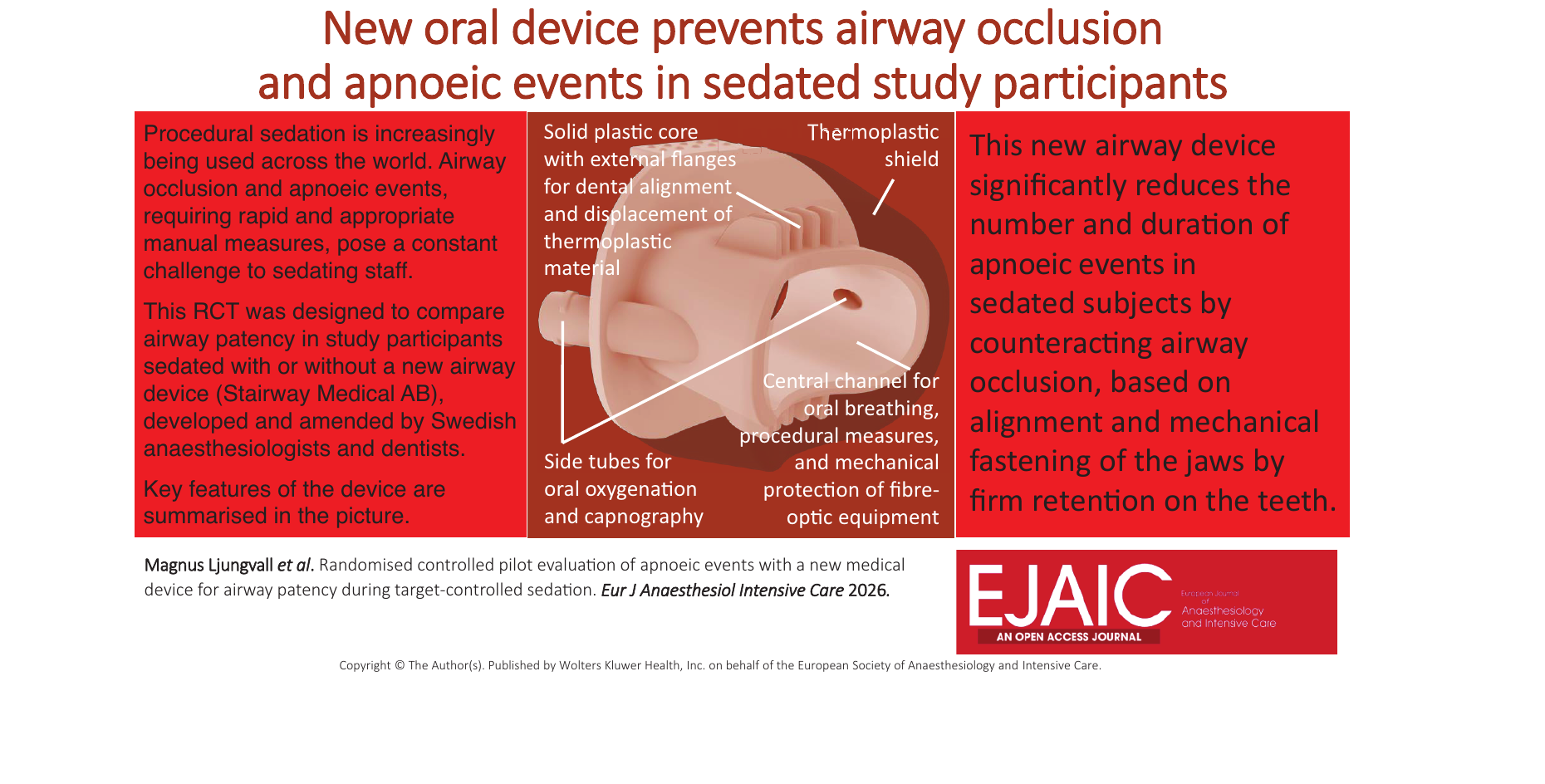
Procedural sedation and analgesia (PSA) is increasingly used inside and outside hospitals worldwide, where upper-airway occlusion and apnoeic events are frequent — particularly as sedation is deepened — and demand rapid manual intervention.
These feasibility-level randomised controlled trials evaluated airway patency in healthy adult volunteers under target-controlled propofol sedation, with versus without a new oral airway device developed by Swedish anaesthesiologists and dentists (Stairway Medical AB, Malmö, Sweden). The device has a solid core with a central channel for spontaneous oral breathing, side-tubes for oxygen supply and oral capnography, and flanges with thermoplastic material for individual dental retention and jaw alignment.
Significantly fewer (median 0 [IQR 0–1] vs 3 [2–4]; P = 0.0015) and cumulatively shorter (0 [0–14] vs 52 [22–96] s; P = 0.0039) apnoeic events were recorded in participants sedated with the device. It was rated adaptable, comfortable and breathable, with no harm or residual adverse effects, and its oral capnography enabled more reliable continuous monitoring of spontaneous breathing.
The authors conclude that medicotechnical promotion of upper-airway patency may be a valuable clinical option for procedural sedation. A larger blinded randomised controlled trial to evaluate clinical usefulness is under way at Lund University.
Published open access in the European Journal of Anaesthesiology and Intensive Care Medicine (2026; 5:5, e0127) under a CC BY-NC-ND 4.0 licence. © The Author(s).