
Conscious sedation safety: why the airway collapses — and what to do about it
Conscious sedation is one of the most widely performed interventions in medicine and dentistry. Its most common serious complication has a single mechanical cause: the jaw stops holding the airway open. This guide explains the mechanism, the depth continuum it hides inside, and the architectural approach STAIRWAY takes.
Procedural sedations performed worldwide each year — over 50 million outside hospitals
Estimated added US healthcare cost per year from sedation complications
Patients sedated outside hospitals are affected by hypoxia
Up to one in five patients sedated in hospitals are affected by hypoxia
What conscious sedation actually is
Conscious sedation — used interchangeably with moderate sedation, procedural sedation and, colloquially, twilight sedation — describes a drug-induced depression of consciousness in which the patient still responds purposefully to verbal or light tactile stimulation, breathes spontaneously, and retains protective airway reflexes.
The clinically important part of that definition is what it does not include: a secured airway. Under general anaesthesia the airway is instrumented and ventilation is controlled. Under conscious sedation, the airway remains the patient's own responsibility — and it depends on muscle tone that the sedative is actively suppressing.
Sedation depth is a continuum, not a setting. Individual pharmacokinetics, comorbidity, body habitus and procedural stimulation move a patient along it during the procedure, often without an intentional change in dosing.
Conscious sedation vs deep sedation vs general anaesthesia
| Depth | Also called | Airway | Spontaneous ventilation |
|---|---|---|---|
| Minimal | Anxiolysis | Unaffected | Unaffected |
| Moderate | Conscious sedation | No intervention usually required — but tone is already falling | Adequate, spontaneous |
| Deep | Deep sedation | Intervention may be required | May be inadequate |
| General | Anaesthesia | Intervention often required | Frequently inadequate |
Because depth drifts, a patient booked for moderate sedation can spend part of the procedure at deep-sedation physiology — with an unprotected airway and no plan for it.
How airway collapse develops
Obstruction during sedation is a mechanical chain, and every link happens before the monitor reacts.
- 01
Muscle tone falls
Sedatives depress the genioglossus and the muscles that hold the mandible forward. Tone drops before the patient looks deeply sedated.
- 02
The jaw drops back
With the mandible unsupported, the tongue base and soft palate fall posteriorly toward the pharyngeal wall.
- 03
The upper airway narrows
Airflow becomes turbulent, then partially obstructed. Snoring and paradoxical chest movement are late, not early, signals.
- 04
Desaturation
Pulse oximetry lags behind the obstruction. By the time SpO₂ falls, the event has already been running for some time.
- 05
Rescue
Jaw thrust, repositioning, or escalation — interrupting the procedure and occupying the sedationist's hands.
Stabilise the jaw, and the airway stays open
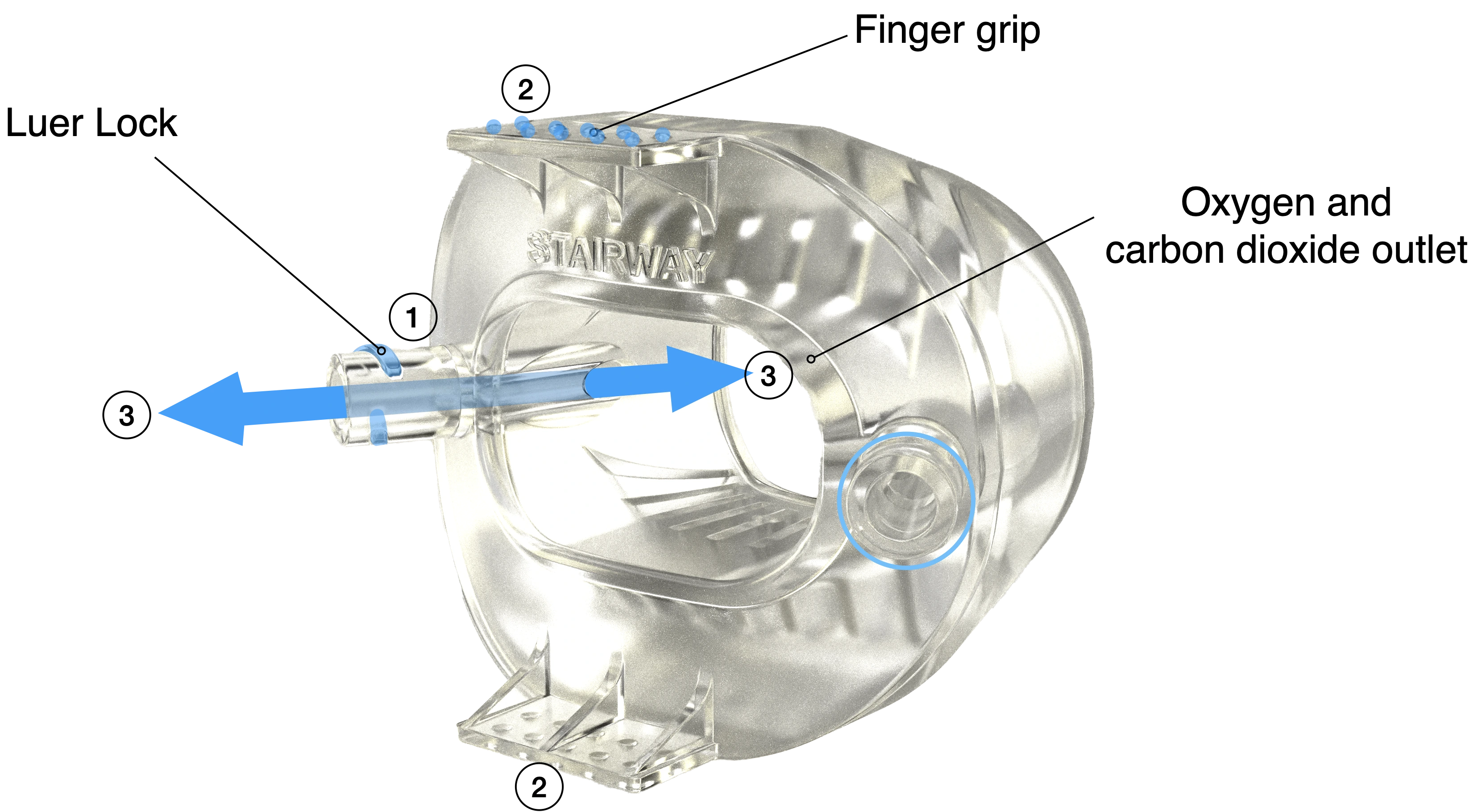
Most airway strategies during conscious sedation are reactive: detect the obstruction, then correct it manually. STAIRWAY takes the opposite approach — it removes the cause by holding the mandible in a stable, forward position for the whole procedure, so the tongue base never falls back in the first place.
Because the support is structural rather than manual, it does not fatigue, does not need to be re-applied every time depth drifts, and leaves the sedationist's hands and attention on the patient rather than on the chin.
The device is designed for the settings where exposure is highest — dental and office-based procedures, endoscopy and other sedation performed outside the operating theatre.
Common questions
- What is conscious sedation?
- Conscious sedation — also called moderate sedation, procedural sedation or twilight sedation — is a drug-induced state in which a patient stays responsive to verbal commands, breathes independently and keeps protective reflexes. It sits between light anxiolysis and general anaesthesia, and depth can shift during a procedure as drugs accumulate.
- How does conscious sedation differ from general anaesthesia?
- Under general anaesthesia the airway is normally secured with an intubation tube or supraglottic device and ventilation is controlled. Under conscious sedation the patient keeps spontaneous breathing and the airway is usually unprotected, so any loss of jaw and tongue support goes straight to the airway.
- Why does the airway collapse during sedation?
- Sedatives reduce tone in the muscles that hold the mandible forward. When the jaw drops back, the tongue base and soft palate fall against the pharyngeal wall and obstruct airflow. This is the same mechanism as obstructive sleep apnoea, but it occurs while the patient is being treated.
- How is airway obstruction usually managed during sedation?
- Traditionally by manual manoeuvres — jaw thrust, chin lift, head repositioning — or by escalating to an airway adjunct. Manual support occupies the sedationist's hands and attention and has to be repeated every time depth changes.
- Where do desaturation events most often occur?
- Sedation outside the operating theatre — dental clinics, endoscopy suites, radiology, office-based procedures — carries the greatest exposure, because monitoring, staffing and rescue equipment are typically leaner than in hospital theatres.
For the research behind the approach, see The Science and our publications.